

By: Heather Campbell, Ruth Everett, Jolene Johnston, and The Rev’d Frank Impicciche
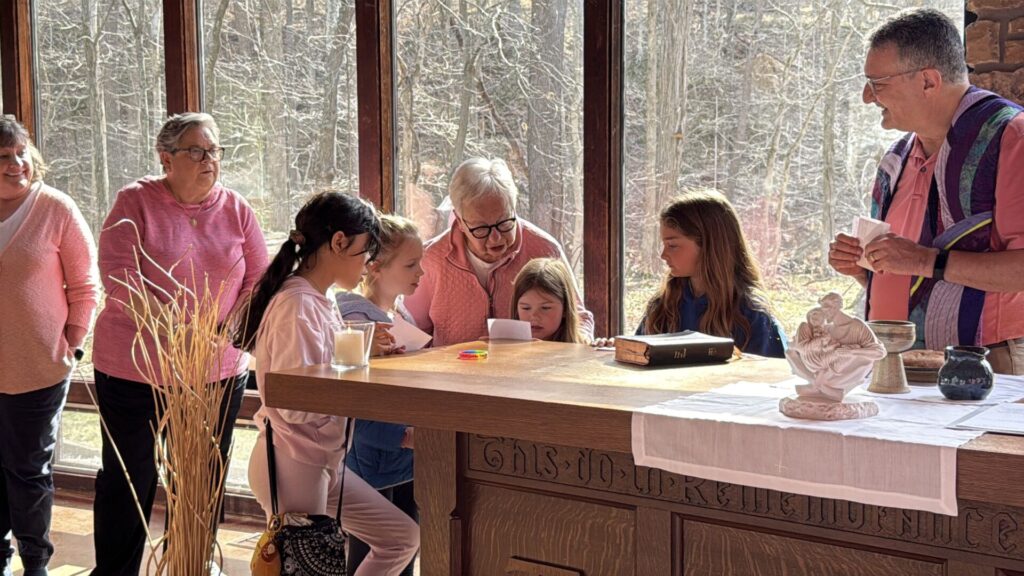
Holy Family Episcopal Church recently went through a change in leadership. The inaugural Youth Ministry University (YMU) cohort presented an opportunity to help reshape their children and youth ministry to include the work of the whole church. What they found, though, was something deeper. Their church experienced a complete cultural shift.
At the beginning of the cohort, they set a goal that was both practical and ambitious. They wanted to weave children and youth ministry into the life of the entire church, not just as siloed programs run by a few leaders. The directors, Ruth and Jolene, envisioned this as something shared across the faith community. Like many churches, they also hoped to increase engagement, volunteer support, and genuine ownership of this ministry work.
Through YMU, that vision started to take shape in concrete ways.
One of the core practices of Youth Ministry University is running “experiments.” That language gave them permission to try things without needing them to be perfect. Some of those experiments were simple. Father Frank began regularly visiting classrooms to build relationships with the children and youth. Over time, trust grew. Students showed up more in worship. There was more ease, more laughter, more connection. The youth weren’t just looking to their leaders anymore. They were building a relationship with their priest, who now openly sees himself as part of their ministry and proudly calls himself a “youth leader,” too.
Another shift came through planning the church calendar together rather than in ministry siloes. Using a YMU framework, Holy Family began aligning formation, worship, and events with more intention. This created space for generations to naturally be together, not just during special events but in the regular rhythm of church life. For example, an unexpected snow day moved the planned kickoff for an adult forum series on baptism and became a meaningful moment for the whole community to gather and learn alongside one another.
Part of YMU is attending at least four of the virtual workshops, which were offered monthly. The first workshop of the year was “Leading your Leaders,” which helped Holy Family rethink their entire volunteer strategy. Rather than recruiting a few people to do everything, they identified individuals’ gifts, availability, and interests. Some helped with events. Others connected youth to outreach opportunities. This approach lowered pressure and increased investment. People weren’t just filling roles; they were contributing as themselves. Over time, leadership expanded organically, and the ministry became richer, more diverse, and more sustainable.
As the year went on, that shift spread beyond their immediate team. Their vestry started talking about intergenerational ministry on its own. Adults began planning with all ages in mind. Young people stepped into new roles in worship and leadership. Experiencing ministry together is becoming more natural as they seek to nourish people and transform lives.
By the time they reached their all-parish Intergenerational Retreat—which the team self-identified as their “capstone” of YMU—the groundwork had already been laid. What emerged was a fully intergenerational experience: worship that was both reverent and accessible, activities that invited participation across ages, and a community willing to be joyful, vulnerable, and fully engaged. At one point, a child asked, “Can we just do this all the time?” It was a simple question, but it captured what many were feeling.
Youth Ministry University didn’t just offer ideas. It gave them a way to move forward with intention. It helped them align what they were doing with what they already believed about church. It also reminded them that they weren’t doing this work alone.
For churches that feel stuck or stretched thin, YMU offers a different path. It creates space to try, to learn, and to build something that lasts. Over time, that work can grow into something many churches long for: a community where people know each other, serve together, and grow in faith side by side.
For Holy Family, the term “holy village” is more than just a hashtag. It is something they are actively living as they continue to build ministry together where no one carries it alone.
Click here to learn more about Youth Ministry University.
