

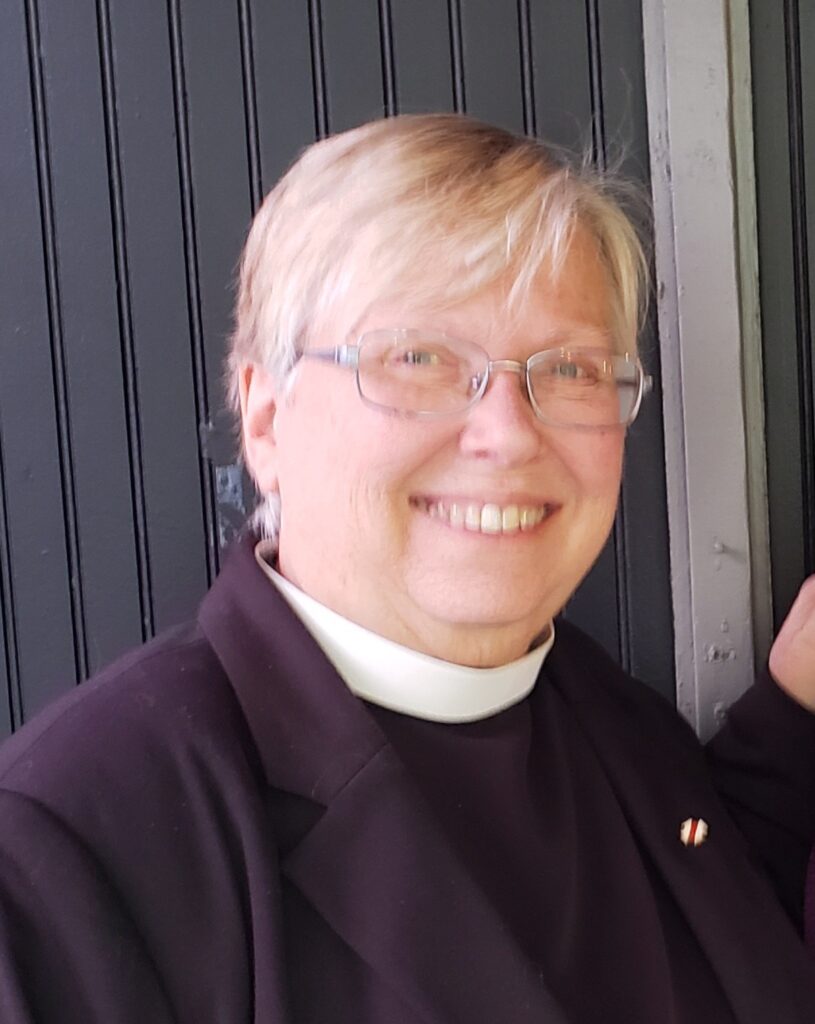
In this deeply personal Q&A, Deacon Cathy reflects on the moment she recognized her vocation not as a priest, but as a deacon — a calling rooted in loving God by loving neighbor. She speaks candidly about what breaks her heart in a world that discards the vulnerable, and how small, faithful acts of justice become holy resistance. She shares how standing at the altar has deepened her gratitude, and why the Church feels most alive when it “prays with its feet.”
If you have ever wondered what it means to say yes to God, and what that yes might ask of you, we invite you to continue reading.
When did you first sense that God might be calling you to ordained ministry and what did that feel like in your body and spirit?
Coming from a Catholic background, I never imagined ordination as that was never an option for women. However, that closed door was not a barrier to hearing God’s call in Micah and Matthew to devote my energies to social justice issues.
My mind and world exploded when I attended the Confirmation of a friend into the Episcopal Church and there were not only women priests, a woman Bishop walked down the aisle at All Saints (Bishop Cate)! When the Rev. Gene Robinson was elevated to Bishop, it was then that my partner Joan and I decided God was opening the door (red, of course) to the Episcopal Church for us.
God was very gentle with me, allowing me space and time to deepen my faith in the inclusive, wider embrace of the Episcopal Church. I didn’t know any deacons, but, on a whim, I attended the ordination of Deacon Karen Sullivan and I was bowled over by the emphasis on social justice in the preaching and in the ordination rite for deacons. God opened my eyes to an outward-focused church that preached and strived to live a Gospel-centered life of care for the poor, the marginalized, and the underserved.
At some point, I had a deep-felt sense that God was calling me into a deeper relationship through ordination as a deacon. I never felt called to the priesthood. For me, being a deacon was (and is) a way of loving God through loving my neighbor. It felt congruent with my life, my values, my relationship with the Holy, my prayer, with everything I hold dear to my heart.
What breaks your heart in this work and how has that shaped the way you serve?
It breaks my heart when people are not valued, are discarded, marginalized, discriminated against by society. It breaks my heart that we live in a society where one step forward = two steps backward with regard to justice work.
This reality has enabled me to find solace and hope in the small acts of love we all can do every day, every hour, that can impact the life of another person or a group of people. As a Daughter of the King, I take comfort in the motto, “For His sake, I am but one, but I am one. I cannot do everything, but I can do something. What I can do, I ought to do. What I ought to do, by the grace of God, I will do. Lord, what will You have me do?” This is a leitmotif of the deacon’s preaching.
While the work of social justice is demanding and unending, it is superseded by the absolute joy of witnessing congregants take up the mantel of justice work as an important aspect of their discipleship.
How has being a deacon changed you?
I have always loved the liturgy, but standing next to the priest at the altar and looking out at the congregation, I am continually humbled and awed at how beautiful, precious, and powerful the folks are, sitting in the pew. I can feel their concerns and fear as much as I can feel their desire to be Christ’s hands and feet in this world. It is a moment of grace to see both the trees and the forest! I take that eucharistic (from the Greek eucharistia for “thanksgiving”) sense with me after every liturgy. Being a deacon has increased my gratefulness in all aspects of my life.
What part of the Church’s life feels most alive to you (the liturgy, being out in the greater community, quiet contemplation, etc)?
The Church is most alive for me when it “prays with its feet” (borrowing from Abraham Joshua Heschel). I love it when the Church shows up in the world, whether that is one person or one hundred people. That witness of Love in action is an antidote to apathy, despair, and cynicism and recalls for me the power for good that is generated when “two or three are gathered in my name.”
Equally important, for me, is the balance I seek by understanding outreach and diaconal work through a more contemplative lens. I need the quiet, lectio divinia, Centering Prayer, and the spiritual writers that have sustained me since the late 1960’s until present: Thomas Merton (foremost), the Berrigan brothers, Jim Forest, Thich Nhat Hanh, Henri Nouwen, Dr. Martin Luther King Jr., Richard Rohr, Rev. Dr. Pauli Murray to name a few.
For someone wondering if this is the path for them, what does it mean to say yes?
“Come and see” what God has in store for you. Come and see how you can be a conduit of God’s love and goodness. Come and see how you can inspire congregants to serve others. Come and see the beauty and the humility of widening your embrace. Come and see how your Yes to God is much more powerful than your fear of the unknown. To quote Mary Oliver in The Summer Day,
“Tell me, what is it you plan to do
With your one wild and precious life?”
